

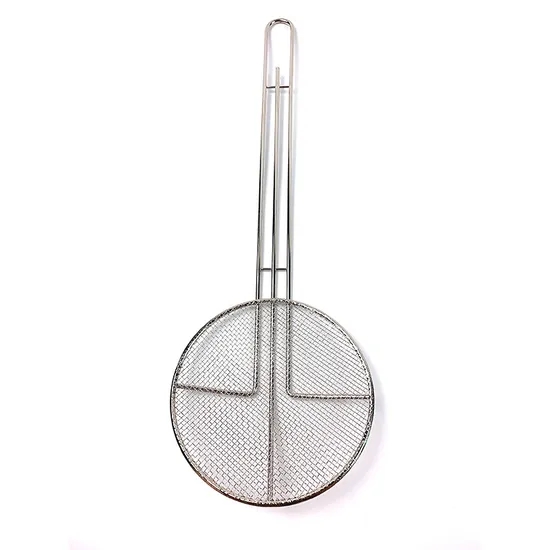
A spider strainer is a long-handled utensil with a wide, shallow wire basket designed to lift food out of hot liquids while draining quickly. In professional kitchens, it is used anywhere speed, heat safety, and clean separation from liquid matter. Compared with a slotted spoon, the spider’s basket supports more weight with less breakage, and compared with a flat skimmer, it can scoop and lift from deeper pots and fryers with better control. This combination makes it a staple tool for fry stations, noodle lines, prep areas, and high-volume service where batch handling is constant.
A well-built spider strainer typically uses stainless steel wire construction so it can handle repeated exposure to boiling water, steam, and fryer temperatures without softening or deforming. In busy kitchens, durability matters as much as function because the tool is used hundreds of times per shift.
The Core Function In One Sentence
In professional kitchens, a spider strainer is used to remove food from hot oil or boiling water quickly while draining excess liquid fast enough to protect texture, reduce oil carryover, and keep the station clean.
Why Professional Kitchens Choose Spider Strainers
Professional kitchens choose spider strainers because they solve three practical problems at once:
-
Speed of drainage
The open wire design lets liquid pass through instantly. This reduces water drag when lifting noodles and reduces oil cling when pulling fried food. -
Capacity without crushing
The wide basket distributes weight, so delicate items like dumplings or tempura are less likely to tear compared with narrow spoons. -
Distance from heat
The long handle keeps hands away from steam and oil splashes, improving safety during peak service.
These advantages are most noticeable when a kitchen must keep output consistent while different staff rotate through the same station.
Main Tasks A Spider Strainer Handles In Commercial Kitchens
Lifting Fried Food Without Excess Oil Carryover
At the fry station, the spider strainer is used to lift items such as fries, chicken bites, seafood, spring rolls, or battered vegetables from hot oil. The basket drains quickly, which helps reduce oil transfer onto trays and improves finished texture.
Operational benefits include:
- Faster draining before dumping into a hotel pan or holding tray
- Better crispness because excess oil drops back into the fryer
- Lower surface oil on food, which improves plating and reduces grease buildup around the station
In high-volume frying, a durable spider strainer supports frequent scooping without bending the basket or loosening joints.
Blanching And Rapid Transfer For Temperature Control
Many kitchens blanch vegetables and then shock them in ice water to lock in color and texture. A spider strainer makes this transfer fast and controlled, especially when working with leafy greens, sliced vegetables, or small items that would slip through tongs.
Common blanch tasks:
- Removing vegetables from boiling water at the exact timing point
- Moving food into an ice bath with minimal delay
- Draining water quickly before service staging
Because timing is critical in blanching, the spider’s speed of lift and drain directly affects product consistency.
Handling Noodles, Dumplings, And Pasta Efficiently
In noodle shops, ramen lines, and busy prep kitchens, spider strainers are used to lift noodles from boiling water and drain them before portioning into bowls or pans. The wide basket reduces clumping and allows fast shaking to remove water, which helps sauce cling properly and prevents watery bowls.
Common uses:
- Lifting ramen or rice noodles in batch portions
- Removing dumplings without tearing wrappers
- Moving pasta from boiling water to a sauce pan in one motion
This is one of the most frequent-use scenarios, which is why handle comfort and basket stability matter.
Skimming Solids From Stocks And Broths
When making stock, kitchens skim bones, aromatics, and cooked particles to keep liquid clean. A spider strainer works well because it can scoop floating solids while allowing broth to drain back, keeping yield high.
Typical applications:
- Removing foam and solids during early stock stages
- Lifting spent aromatics and bones after simmering
- Clearing broth before final filtration
For this task, a spider strainer is often used alongside finer strainers, with the spider doing the heavy lifting first.
Retrieving Items From Large Pots And Deep Containers
In large-format cooking, items can sink or float in awkward positions. A spider strainer gives reach and control when retrieving eggs, poached items, par-cooked vegetables, or small seafood from deep pots.
This reduces:
- Hand exposure to steam and boiling water
- Time spent fishing for items with narrow utensils
- Breakage of delicate food during retrieval
What Makes A Spider Strainer Commercial-Grade
Not all spider strainers hold up in professional kitchens. Buyers usually evaluate these points because they affect longevity and daily performance.
Basket Wire Thickness And Rigidity
Thicker wire and well-formed basket geometry improve load capacity and reduce deformation. In practical terms, the basket should not flex excessively when lifting a full portion. Rigidity also improves draining speed because the basket shape stays consistent.
Joint Strength Between Basket And Handle
The basket-to-handle connection takes the most stress. Reinforced welding or robust fastening prevents wobble and reduces failure risk when the tool is used continuously.
Handle Length And Heat Management
Longer handles protect users from steam and oil splatter, especially when reaching into deep fryers or stock pots. A comfortable grip reduces fatigue, which matters in high-output service.
Surface Finish And Cleaning Efficiency
A smooth stainless surface sheds residue more easily and cleans faster. This reduces scrubbing time and helps maintain hygiene standards between shifts.
When kitchens source for long-term use, they typically prefer a stainless steel spider strainer that remains stable after repeated washing and high-temperature contact.
Spider Strainer Vs Other Tools
A spider strainer overlaps with several utensils, but the differences are clear in high-volume work.
-
Versus slotted spoon
A slotted spoon is good for small portions but lacks capacity and drains slower when loaded. The spider handles batch work with less spill and less crushing. -
Versus flat skimmer
A flat skimmer is effective for surface debris but is less useful for deep retrieval or lifting heavier portions from below the surface. -
Versus tongs
Tongs work well for large pieces but are inefficient for small items like fries, dumplings, or noodles where a scoop-and-drain motion is faster.
Many professional kitchens keep multiple tools, but the spider strainer is often the fastest for repeated lift-and-drain tasks.
Cleaning And Maintenance In Professional Kitchens
A spider strainer should be cleaned promptly after use to prevent starch, batter, or protein residue from drying on the wires.
Best practices:
- Rinse immediately after service to remove oil or starch
- Wash with warm water and food-safe detergent
- Brush lightly at wire intersections if residue builds up
- Dry fully before storage to prevent water spots and keep the tool clean
For operations using commercial dishwashers, stainless tools generally tolerate repeated cycles well when stored properly and not bent during loading.
How To Choose The Right Spider Strainer For Your Operation
Selection should match station needs rather than choosing one generic size for everything.
A practical buying checklist:
- Basket diameter matched to pot or fryer opening
- Handle length suited to fryer depth and pot height
- Wire rigidity suited to typical portion weight
- Connection strength suitable for continuous use
- Easy-clean finish that supports fast turnover
For project buyers standardizing tools across multiple kitchens, a custom spider strainer specification can help align size, handle style, and packaging requirements to support consistent training and inventory management.
Conclusion
In professional kitchens, a spider strainer is used to lift and drain food from hot oil, boiling water, and broths with speed and control. It supports frying, blanching, noodle handling, dumpling retrieval, and stock skimming while improving workflow efficiency and reducing heat exposure. The best performance comes from stable stainless construction, a rigid basket, and a strong basket-to-handle connection that holds up under daily high-volume use.
If you are sourcing spider strainers for long-term service or planning a bulk order with consistent specifications, Yonghao Hardware can support OEM requirements for size, finish, packaging, and project-ready supply. Share your station type, portion volume, and cleaning routine, and we can recommend a configuration suited to your workflow.