

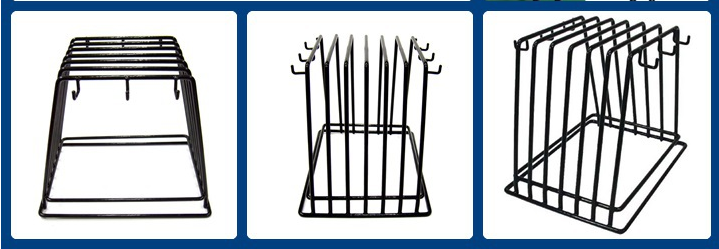
A cutting board drying rack is a dedicated storage and airflow solution designed to hold cutting boards vertically so they can drain and dry evenly after washing. In professional kitchens, it plays a direct role in hygiene control, space efficiency, and board longevity. By separating boards into individual slots and keeping them upright, a drying rack prevents moisture trapping, reduces contact surfaces, and supports faster, more consistent drying between uses.
Unlike stacking boards flat on counters or leaning them against walls, a proper drying rack establishes a controlled drying position that aligns with commercial sanitation standards and daily workflow demands.
The Core Purpose In Professional Kitchens
The primary purpose of a cutting board drying rack is moisture management. After washing and sanitizing, cutting boards retain water on surfaces and along edges. If boards are stacked or stored flat while wet, moisture becomes trapped, creating conditions that encourage odor, surface degradation, and hygiene issues.
A drying rack solves this by:
- Holding boards vertically so gravity drains water naturally
- Allowing air to circulate on both sides of each board
- Keeping boards physically separated to avoid cross-contact
- Organizing boards in a fixed, repeatable position
For kitchens handling raw proteins, produce, and ready-to-eat foods, this controlled separation is essential.
How A Cutting Board Drying Rack Works
A cutting board drying rack works through vertical slot separation and open airflow. Each board is placed into an individual slot, usually spaced evenly to prevent boards from touching. The open-frame design allows air to move freely around surfaces, accelerating evaporation.
Key working principles include:
- Vertical orientation to promote drainage
- Slot spacing to eliminate surface-to-surface contact
- Open structure to avoid moisture buildup
- Stable base to prevent tipping or sliding during loading
This simple mechanical design is effective because it relies on gravity and airflow rather than heat or forced drying.
Common Rack Designs And Structures
Most commercial cutting board drying racks follow a similar structural logic, even if sizes vary.
Vertical Slot Racks
These racks feature parallel slots sized to accommodate standard cutting board thicknesses. Boards slide in and out easily, making them suitable for high-frequency use.
Countertop Racks
Compact racks designed for prep areas where boards are washed and reused frequently. They minimize movement between wash and prep zones.
Wall-Mounted Or Shelf-Integrated Racks
Used where counter space is limited. These keep boards elevated and out of splash zones while maintaining airflow.
Regardless of format, durability and spacing accuracy determine long-term performance.
Materials Used In Commercial Drying Racks
In professional kitchens, cutting board drying racks are typically made from stainless steel or coated metal.
Stainless steel racks are preferred because they:
- Resist corrosion from constant moisture exposure
- Tolerate frequent cleaning and sanitizing
- Maintain structural rigidity under load
- Do not absorb water or odors
A durable cutting board drying rack must remain stable even when fully loaded with thick commercial boards.
Hygiene And Cross-Contamination Control
Drying racks support hygiene protocols by enforcing separation. When boards are assigned by food type, the rack maintains physical spacing during drying, reducing accidental contact.
Operational benefits include:
- Clear visual organization of board sets
- Reduced risk of board surfaces touching while wet
- Easier inspection during sanitation checks
- Faster readiness for the next prep cycle
In environments with color-coded boards, racks also help preserve order and workflow discipline.
Why Racks Matter More Than Flat Storage
Flat storage is one of the most common causes of board-related issues in professional kitchens. When boards are stacked wet:
- Moisture is trapped between surfaces
- Drying time increases significantly
- Odors develop more easily
- Board materials degrade faster
A drying rack eliminates these issues by design. It standardizes how boards are stored immediately after washing, removing guesswork from staff routines.
Selecting The Right Drying Rack For Your Operation
When choosing a cutting board drying rack, professional buyers typically evaluate:
- Number of slots and spacing width
- Compatibility with board thickness and size
- Structural stability when fully loaded
- Ease of cleaning around and under the rack
- Placement relative to wash and prep areas
For high-volume kitchens, matching rack capacity to daily board turnover prevents congestion and improper storage shortcuts.
Cleaning And Maintenance Considerations
A drying rack itself must be easy to clean to avoid becoming a contamination point.
Best practices include:
- Open-frame designs with no trapped corners
- Smooth welds and finishes
- Regular wiping and sanitizing
- Keeping the rack dry between wash cycles
Stainless steel racks integrate well into standard commercial cleaning routines.
Conclusion
A cutting board drying rack is a functional hygiene tool designed to dry cutting boards efficiently through vertical storage and unrestricted airflow. In professional kitchens, it supports sanitation standards, prevents moisture-related issues, and improves workflow consistency. By keeping boards separated, upright, and organized, the rack reduces contamination risk and extends board service life.
For operations standardizing kitchen storage or sourcing equipment for long-term use, Yonghao Hardware provides durable drying rack solutions with OEM options tailored to board size, capacity, and placement requirements. Selecting the right rack helps ensure cleaner, safer, and more efficient daily kitchen operations.