

A batter dispenser is a portion-control tool designed to release liquid or semi-liquid batter in a controlled, repeatable way. It is widely used in commercial kitchens, bakeries, breakfast service lines, and catering operations to improve consistency, speed, and cleanliness when dispensing pancake batter, waffle batter, crepe mix, or similar mixtures. Rather than pouring batter manually, a dispenser uses gravity and a mechanical valve system to control flow and portion size.
Understanding how a batter dispenser works helps operators choose the right model, use it correctly, and avoid common issues such as dripping, clogging, or inconsistent portions.
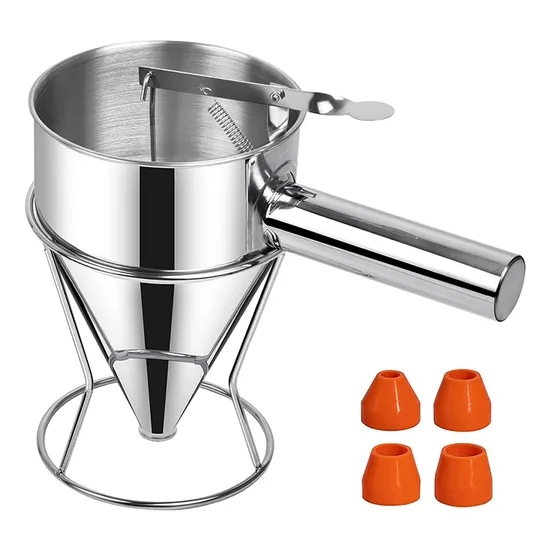
The Basic Working Principle
At its core, a batter dispenser works through gravity-fed flow control. Batter is poured into a container or chamber, and when the user activates a handle or trigger, a valve opens at the bottom. Gravity pulls the batter downward, allowing it to flow out through the opening. Releasing the handle closes the valve, stopping the flow.
The accuracy of a batter dispenser depends on three elements working together:
- The consistency of the batter
- The valve design and sealing precision
- The user’s control of opening time
Because no pumps or motors are involved in most manual models, reliability is high and maintenance is simple.
Key Components And Their Functions
Although designs vary, most batter dispensers share the same core components.
Container Or Hopper
The container holds the batter and determines total capacity. In commercial use, this is often sized to support continuous service without frequent refilling. The container shape helps guide batter smoothly toward the outlet, minimizing air pockets that could interrupt flow.
Valve Mechanism
The valve is the most critical working part. It sits at the bottom of the dispenser and controls when batter is released. When closed, it seals tightly to prevent dripping. When opened, it creates a clear path for batter to exit.
A well-designed valve must:
- Open smoothly without sudden surges
- Close cleanly to stop flow immediately
- Resist sticking caused by thick or sugary batter
This is why durable batter dispenser designs focus heavily on valve fit and surface finish.
Handle Or Trigger System
The handle connects directly to the valve. Pressing or squeezing the handle lifts or rotates the valve open. Releasing it returns the valve to the closed position, usually with the help of gravity or a spring.
Handle leverage affects user comfort and portion accuracy. Smooth handle movement allows better timing control, which leads to more consistent portions.
Outlet Opening
The outlet size influences flow speed. Larger openings allow thicker batter to pass without clogging, while smaller openings provide finer control for thinner mixtures. Matching outlet size to batter viscosity is essential for stable operation.
Step-By-Step Dispensing Process
A batter dispenser works through a simple, repeatable sequence:
- Batter is poured into the container and allowed to settle.
- The dispenser is held above the cooking surface.
- The user presses the handle, opening the valve.
- Batter flows downward by gravity.
- The user releases the handle.
- The valve closes, stopping the flow instantly.
When this process is repeated with consistent timing, portion sizes remain uniform across multiple servings.
How Batter Consistency Affects Performance
Batter viscosity has a direct impact on how a dispenser behaves.
Thin batters flow quickly and respond immediately when the valve opens or closes. Thick batters move more slowly and require a slightly longer open time to release the same volume. If batter is too thick, it may not flow evenly, increasing the risk of incomplete portions or valve sticking.
In professional kitchens, operators often standardize batter recipes to match their dispenser setup. This ensures reliable flow and reduces operator variation.
Portion Control And Accuracy
Unlike measuring cups, batter dispensers rely on time-controlled flow rather than fixed volume chambers. Portion size is determined by:
- Valve opening size
- Batter thickness
- Duration the valve remains open
Experienced operators quickly develop consistent timing, which is why dispensers are especially effective in high-volume service where speed and uniformity matter more than single-serve precision.
For projects that require tighter portion control, selecting a commercial-grade batter dispenser with stable valve tolerances helps reduce variation over long service periods.
Common Issues And How The Design Addresses Them
Well-designed dispensers are built to minimize common problems.
Dripping occurs when the valve does not seal fully. This is usually related to wear, poor alignment, or batter residue on the sealing surface.
Clogging happens when batter contains unmixed lumps or when outlet size is too small for the batter thickness.
Inconsistent flow often results from air pockets or uneven batter consistency.
A durable batter dispenser addresses these issues through smooth internal surfaces, precise valve fit, and outlet dimensions suited for foodservice batter types.
Cleaning And Resetting The System
Cleaning is part of how the dispenser continues to work correctly. After use:
- Remaining batter is emptied
- The valve area is rinsed to remove residue
- Components are washed and dried before reassembly
Proper cleaning ensures the valve closes fully during the next use and maintains predictable flow behavior.
Conclusion
A batter dispenser works by combining gravity-fed flow with a manually controlled valve system to release batter cleanly, consistently, and efficiently. Its performance depends on valve design, batter consistency, and user control rather than complex mechanics. When used correctly, it improves portion uniformity, reduces mess, and speeds up service in commercial food preparation environments.
For kitchens or project buyers sourcing batter dispensers for long-term use, Yonghao Hardware supports stable manufacturing and OEM customization options, helping match dispenser design to real service conditions and workflow requirements.